Cocaine reaches West Africa by sea and air. Loads then divide between a Senegal–Mali trunk, a Mauritania–Mali branch and a Niger route toward Libya. Public reporting documents the northern Mali branch toward Algeria less well.
ASSESSMENT / 07SAHEL · TRAFFICKING AND POLITICAL POWER
DRUG ROUTES AND POLITICAL POWER
Cocaine across the Sahel: the protection economy
Traffickers can change roads after a seizure. They still need brokers, officials and armed protectors who can move a shipment through the next jurisdiction.
Assessment in brief
Traffickers buy information, documents, passage and protection. Officials, business owners, community figures and armed groups can earn money without owning the cocaine.
States need financial and corruption cases that cross the coast-Sahel divide. A seizure at a checkpoint removes one load and leaves the protection network in place.
A shipment can enter through a port, an airfield or a coastal landing. Transporters divide it, change vehicles and move it through several jurisdictions. The road matters for one journey. The people who sell protection decide whether the business survives the next one.
West African networks absorb a global cocaine surplus
UNODC estimated global cocaine production at more than 3,708 tonnes in 2023, a record and an increase of about one third from 2022. The agency placed the number of users at 25 million, up from 17 million in 2013. Trafficking organisations respond to European demand and record South American output by opening extra routes and dividing risk among them.
Traffickers use West Africa's Atlantic ports, commercial flights, fishing fleets and road links into North Africa. They buy storage, transport, finance and contacts on both sides of the Atlantic.
A Gulfstream IV landed in Guinea-Bissau from Venezuela in September 2024. Police seized 2.63 tonnes of cocaine and detained the five-person crew. Senegalese authorities had seized three tonnes at sea in December 2023. They seized 1,137 kilograms at Kidira, on the Malian border, in April 2024.
Police intercepted those shipments at different stages. The Guinea-Bissau case records direct transatlantic aviation. Senegal's navy found an offshore load. Customs officers at Kidira found cocaine after it had reached the continental road network. Investigators cannot reconstruct undetected shipments from those events.
Algeria sits on the northern edge of the network
Northern Mali borders Algeria. A 2023 UN panel identified Gao and Kidal as contested trafficking zones and described Mali as a link between Gulf of Guinea states and North Africa. That record supports an Algeria-facing branch from the Gao–Kidal corridor.
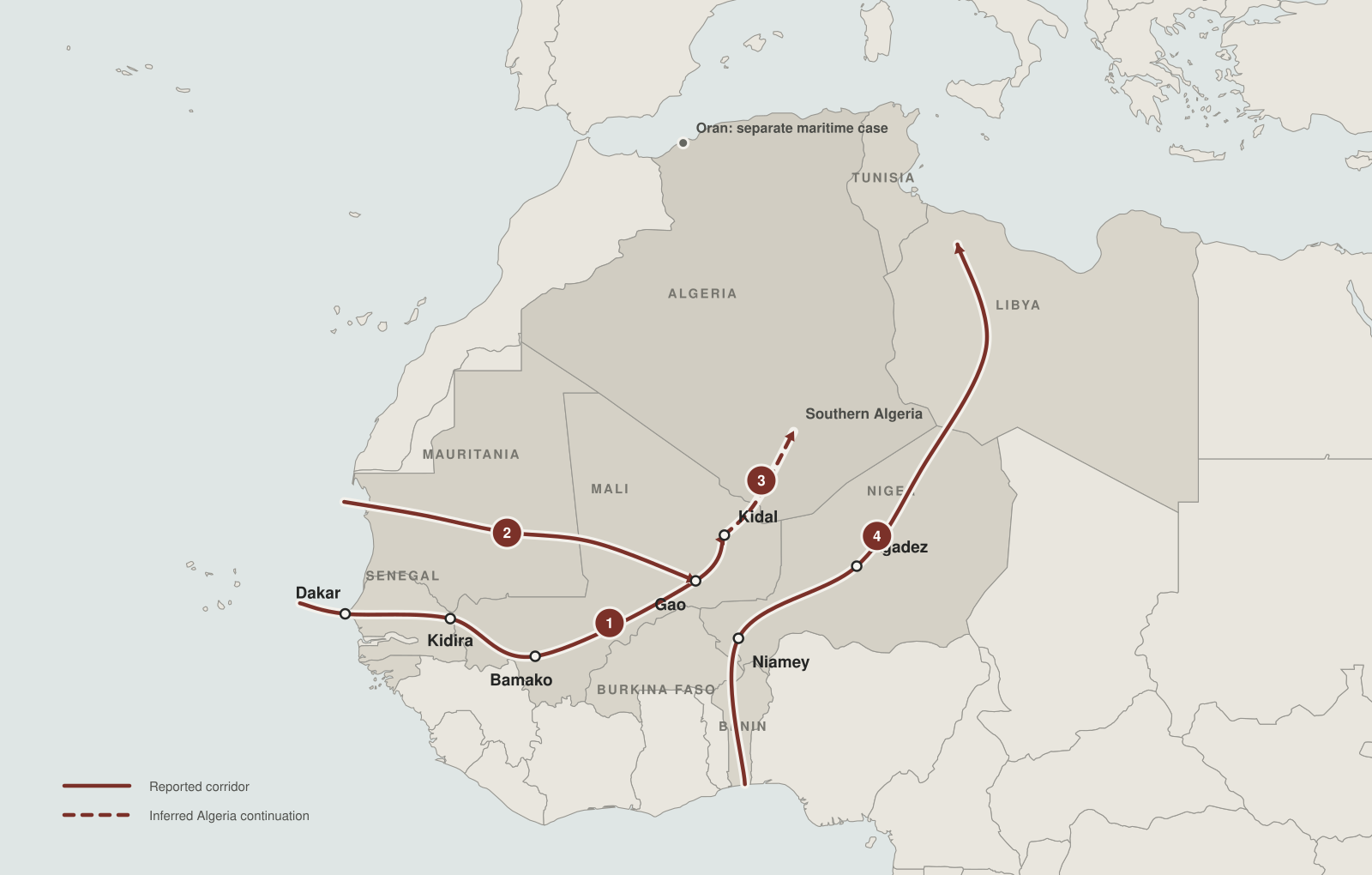
The public record contains few cases that follow one cocaine load from a West African landing to a named destination in Algeria. The map draws the segment from Kidal toward southern Algeria with a dashed line and a medium-confidence rating. It represents the reported North Africa corridor and the Algerian connection. It does not claim that every load follows that path.
Reporting on the Niger branch gives a clearer northern sequence: coastal supply enters Niger, reaches Agadez and moves toward Libya, Tunisia and Europe. Algeria forms part of the same regional trafficking environment, but published accounts of loads leaving Agadez name Libya more than Algeria.
Algeria also receives cocaine without a Sahel crossing. Authorities seized 701 kilograms at Oran in 2018 from a ship carrying Brazilian cargo through Las Palmas and Valencia. A grey point marks Oran. The map leaves it unconnected to the Sahel corridors because the shipment came by sea.
The route ledger
The map and table record country-level corridors supported by public reporting. They omit current minor roads, crossing schedules and concealment details. Solid lines connect segments named in public reporting. The dashed line marks an inferred continuation whose exact crossing remains unproved.
EVIDENCE MAP
The northern routes split
The map isolates four cocaine corridors. Route 3 uses a dashed line because public sources do not trace a shipment across the full Mali–Algeria leg. The Oran marker records a separate maritime case. The ledger below covers cannabis resin.
ROUTE KEY
- 01Senegal–Mali trunk
Dakar / Kidira → Bamako → Gao / Kidal
High confidence - 02Mauritania–Mali branch
Atlantic entry → Mauritania → northern Mali
Medium-high confidence - 03Algeria-facing branch
Gao / Kidal → southern Algeria / wider Maghreb
Medium confidence - 04Niger–Libya branch
Gulf of Guinea → Niamey → Agadez → Libya
Medium-high confidence
Map scopeCocaine corridors only. The full ledger records cannabis resin and the Oran maritime chain.
ROUTE LEDGER
Recorded country-level corridors
Confidence reflects public evidence for the corridor. It does not estimate the share of regional traffic.
| Flow | Country-level chain | Evidence | Confidence |
|---|---|---|---|
| Atlantic cocaine entry | South America to Guinea-Bissau, Cabo Verde, Senegal and other Atlantic landing points; onward by sea, air or road | Guinea-Bissau seized 2.63 tonnes from an aircraft that arrived from Venezuela in September 2024. Senegal recorded multi-tonne maritime and land seizures in 2023 and 2024. | |
| Senegal–Mali trunk | Dakar and Kidira into Bamako; onward through the Gao and Kidal regions | Senegal seized 1,137 kilograms at Kidira on the Malian border in April 2024. A UN panel identified Bamako-based dealers and competition over routes through Gao and Kidal. | |
| Mali–Algeria-facing branch | Gao and Kidal toward southern Algeria and the wider Maghreb | The UN panel documents Gao and Kidal as route zones between coastal West Africa and North Africa. Public sources reviewed for this report do not prove one continuous shipment from Kidal to an Algerian destination. | |
| Mauritania–Mali branch | Atlantic West African entry points through Mauritania or western Mali; onward toward the Maghreb and Europe | UNODC and Le Monde identify Mauritania and Mali in the overland movement of cocaine from West African entry points toward the Maghreb and Europe. | |
| Gulf–Niger–Libya branch | Gulf of Guinea supply into Niger; Niamey and Agadez toward Libya, Tunisia and Europe | Field reporting identifies Agadez as a cocaine hub and describes substantial loads moving through Mali and Niger toward Libya and Tunisia. | |
| Cannabis resin and exchange | Morocco south through Mauritania and Mali, then east into Sahelian markets; cocaine can move in the opposite direction | UNODC ranks cannabis resin ahead of cocaine in Sahel seizures. Researchers report direct exchanges of Moroccan hashish for South American cocaine in West Africa. | |
| Direct maritime Algeria case | Brazil through Las Palmas and Valencia toward Oran | Algerian authorities seized 701 kilograms at Oran in 2018. The case shows direct maritime supply to Algeria. Researchers should separate it from Sahel crossings. |
The network sits above the road
The familiar image shows pickup trucks crossing an empty desert. Large cases start elsewhere. International wholesalers arrange supply. Aviation or maritime contacts receive it. Brokers find storage, transport and buyers. Officials can provide documents, warnings or a decision not to inspect.
A 2023 UN panel described terrorist groups, signatories to Mali's former peace agreement and transnational criminal networks competing over routes through Gao and Kidal. The panel called Mali a hub between Gulf of Guinea coastal states and North Africa in both directions. It reported that many major dealers lived in Bamako.
Investigators should follow the Bamako connection. Distance from state control can help a convoy. The deal can depend on people inside a capital, port authority, customs service or licensed company. A strategy aimed at remote drivers can spare the organisers who select the load, arrange payment and settle disputes.
European and South American groups supply and finance parts of the chain. European investigators broke up a Balkan network in 2024 that used logistics hubs in West Africa and the Canary Islands. Le Monde reported links among Brazil's First Capital Command, African intermediaries and European organisations, including the 'Ndrangheta. No single cartel owns the Sahel route.
Protection creates the political market
Traffickers need a series of permissions. A transport owner accepts a load. A broker chooses a warehouse. An official changes a document or shares an inspection schedule. An armed actor allows passage through territory it influences. Each participant can sell a service without buying the shipment.
International Crisis Group traced how drug profits fed political and military competition in northern Mali before and after the 2012 rebellion. Traffickers built relationships with state officials, community leaders and armed movements. Those relationships turned commercial disputes into political conflicts and gave armed entrepreneurs money to recruit and equip men.
UNODC reached a related finding in 2024. The agency identified political elites, community leaders and armed-group leaders as facilitators. Corrupt officials and money launderers connect the remote movement of a load to institutions that can protect ownership and profit.
Armed groups can tax a road, escort a convoy, protect a warehouse or punish a rival. Some ban a commodity or attack transporters. Researchers need evidence about the contract and payment before they label a group the owner of a trafficking network.
Investigators need a narrower narco-jihadist test
Jihadist figures and drug traffickers have shared personnel, territory and business relationships in the Sahel. Armed groups profit from routes under their influence. Investigators have grounds to examine specific commanders and transactions.
Public evidence does not show JNIM directing the regional cocaine market. UN reports describe competition among jihadists, former rebel groups, political figures and criminal organisations. They describe taxation and facilitation alongside direct trafficking. The mechanism changes by place and actor.
Governments gain from a simpler story. A narco-jihadist label directs attention toward insurgent territory and away from customs fraud, aviation access, police protection and money laundering. It can turn traders and pastoral communities into suspects while senior organisers retain political cover.
Seizures measure police contact with the market
UNODC reported that Mali, Chad, Burkina Faso and Niger seized 1,466 kilograms of cocaine in 2022. The same states had recorded an annual average of 13 kilograms between 2013 and 2020. The increase gives strong evidence that cocaine had gained a larger presence in the Sahel.
Researchers cannot turn the ratio into a flow estimate. Police may seize more because traffickers move more. They may have better intelligence, equipment or incentives to report. Researchers should test any estimate against evidence about enforcement and corruption.
Agencies can distort a seizure when they use destination retail prices for a load intercepted far from that market. The resulting figure can exaggerate the money available to a local transporter. Analysts should report weight, purity, location, stage of movement and valuation method.
Court outcomes matter as much as seizure photos. Authorities should publish whether prosecutors charged the owner, transporter and protecting official; whether judges admitted the evidence; and whether the state recovered assets. A burned pile of cocaine cannot answer those questions.
Transporters seed local drug markets
Lower-level transporters may receive cocaine instead of cash. They sell part of that payment near the route. Lucia Bird of the Global Initiative Against Transnational Organized Crime linked payment in kind to reports of growing crack use in Agadez.
The Guardian documented women in Agadez who used crack while trapped in debt and sex work. Service providers described a cycle in which transport debt, exploitation and drug dependence reinforced one another. Europe receives part of the shipment. Sahelian communities absorb part of the health cost.
Retail sellers add cocaine to an existing market. Cannabis resin remains the most seized drug in the Sahel. Nigerien forces have intercepted tramadol with cannabis, while UNODC has warned that African markets contain cocaine, pharmaceutical opioids and synthetic mixtures alongside cannabis.
Governments that treat every drug budget as an enforcement budget leave that market untreated. Hospitals need toxicology, overdose care and referral systems. Community services need confidential treatment that does not expose a patient to arrest.
Investigate the protection network
Coastal and Sahelian investigators should build joint cases around shipments, companies, phones, payments and assets. The case team needs customs, financial intelligence, prosecutors and anti-corruption staff. Military patrols can support an interception. They cannot audit a logistics company or trace a payment.
Governments should publish common seizure fields: date, broad location, substance, tested weight and purity, transport mode, agency, arrests, charges and final court result. Regional analysts could then distinguish a route change from a change in reporting.
Investigators should follow protection upward. Asset declarations, unexplained wealth inquiries, procurement records and company ownership can expose officials and business figures who never touch a packet. Witness-protection rules matter when a customs officer names a superior or a driver names an armed commander.
States should protect lawful mobility. Traders, herders and transport workers use the same broad corridors as traffickers. Collective restrictions raise prices, invite extortion and give armed groups another service to sell. Intelligence-led cases place the burden on investigators instead of border communities.
Traffickers, officials and armed groups keep the trade moving through separate protection deals. Investigators can arrest a transporter and seize a load. The organisers retain their network until a court dismantles those deals and recovers the profit.
CLAIM LEDGER
What the evidence can carry
The ratings measure support in the sources reviewed. Seizure records cannot establish the full size or ownership of an illegal market.
| Claim | Assessment | Rating |
|---|---|---|
| Cocaine follows one fixed road across the Sahel. | Public cases show maritime, aviation and land entry, followed by western and central overland branches. Traffickers change jurisdictions and transport methods after enforcement pressure. | |
| Jihadist groups control the Sahelian cocaine trade. | UN reporting links armed groups to route competition, taxation and protection. The same reporting identifies political elites, community leaders, transnational networks and Bamako-based dealers. Public evidence does not establish JNIM or Islamic State control over the regional market. | |
| The rise in seizures proves the flow rose by the same amount. | The change from a 13-kilogram annual average in 2013-2020 to 1,466 kilograms in 2022 across four Sahel states supports a larger trafficking presence. Seizures reflect enforcement capacity, intelligence and reporting as well as market activity. | |
| West Africa serves as a transit zone, not a consumer market. | Researchers and service providers report crack use in Agadez, including payment in cocaine to lower-level transporters. UNODC reports a broader diversification of African drug markets. | |
| More desert patrols can dismantle the routes. | Patrols can intercept loads. Durable disruption requires investigators to identify corrupt protection, ownership, payments and laundering across ports, aviation, customs and political networks. |
SOURCE DESK
Sources and limits
Research cut-off: 13 July 2026. Daniel reviewed UN drug-market reporting, a UN sanctions-monitoring account, police cases and field reporting. The map uses Natural Earth boundaries and keeps routes at country and hub level. It does not publish current minor roads, crossing schedules, concealment methods or checkpoint vulnerabilities.
Seizures provide verified events. They do not give a denominator for total traffic. Armed-group involvement varies among ownership, transport, protection, taxation and extortion. The source record does not support one regional model.
AI-assisted tools helped search, compare and translate source material and build the evidence map and publication page. Daniel checked the cited pages, tested route claims against several sources and approved the assessment under his name. Read the method policy.
- 01World Drug Report 2025 ↗UN Office on Drugs and Crime, June 2025
- 02Drug trafficking in the Sahel ↗UNODC Transnational Organized Crime Threat Assessment, April 2024
- 03The West African Sahel is becoming a drug smuggling corridor ↗Associated Press, 19 April 2024
- 04Guinea-Bissau police seize 2.63 tonnes of cocaine from aircraft ↗Reuters, 9 September 2024
- 05Senegal becomes a cocaine transit platform and consumer market ↗Le Monde, 7 June 2024
- 06UN experts describe competition over trade and trafficking routes in Mali ↗Associated Press, 28 August 2023
- 07Drug trafficking, violence and politics in northern Mali ↗International Crisis Group, 13 December 2018
- 08A cycle of debt, sex work and cocaine in Agadez ↗The Guardian, 14 June 2024
- 09African drug markets diversify as cocaine and synthetic drugs spread ↗Reuters, 26 June 2024
- 10Balkan cartel used West African and Canary Islands logistics hubs ↗The Guardian, 13 June 2024
- 11Global cocaine production and use reached new records in 2023 ↗Reuters, 26 June 2025
- 12The 701-kilogram cocaine case and corruption in Algeria ↗Le Monde, 15 June 2025